VC Fund Raising Manual – 9 Money in the Bank

Congratulations, you just closed a funding round, and the money is in the bank.

Before you become very excited, I suggest you take this piece of advice very seriously: DON’T SPEND THE MONEY

Or at least, don’t overspend. If you raise $10m, this can last you 18 months or it can last you three years or maybe even five. If you spend all the money too fast, all sorts of bad things will happen:

– You will have the need to raise more money, meaning your shareholding will get further diluted.

– The post money valuation of you company increases, increasing the size of a meaningful exit for your investors. Don’t get me wrong, building a large company is a good thing. But having the absolute need to build a company that is larger than the opportunity really allows for can cause a company to fail unnecessarily. I have seen that happen in the past, it is not fun at all. Build the biggest company that you can build, but give yourself the luxury to make your investors happy even should the company only sell for a comparatively modest amount of money.

This concludes the VC Fund Raising Manual. Last thing from me is: Good luck.

This article is part of a series, you can find the index here.

AddThis Social Bookmark Button Subscribe in a Reader Subscribe by Email

Reblog this post [with Zemanta]

VC Fund Raising Manual – 8 Legal Work

You did it, you signed a term sheet with a VC. What will happen now is that the VC firm will do some final due diligence, and you will start to put into legal form what you have agreed in the term sheet.

This article is part of the a series, you can find the index here.

Here is what should happen now:

– Accounting due diligence

– Legal due diligence

– Drawing up the investment agreement and amendments to your company’s articles of association (called differently in different countries)

What should NOT happen (in a VC deal, buyouts are different):

– Further commercial due diligence

– Further references on founders

– Further technical due diligence

– Any other funny stuff

The work items directly above should have been completed before you signed the term sheet. I suggest you do not sign a term sheet before they are complete. Again this is true for VC deals, in buyout deals, the deal process is slightly different.

A quick word on drawing up the legal documents. What frequently happens is that the VC will use and amend some sort of ‘standard’ document that they use all the time. This standard document can, for example, be based on suggested documents drawn up by a venture capital association. The VC will tell you these documents are totally ‘standard’. My thoughts on this are as follows:

– Documents drawn up by bodies that represent VCs are not unbiased. They are in favor of the VC firm.

– Standard documents are usually the very long versions. There will be a lot of paragraphs in here you can do with out.

– Any contract is a commercial agreement before it is a legal agreement. The legal form and language are there to serve a commercial purpose, not the other way round. Discuss the commercial aspects with the VC directly, not via the lawyer, and come to an agreement. Then instruct your lawyers to put that in legal wording. Use your lawyer effectively.

Expect this process to take some 4-8 weeks. If everything goes well, then you are ready for the final stage: getting the money in the bank.

AddThis Social Bookmark Button Subscribe in a Reader Subscribe by Email

Reblog this post [with Zemanta]

Where are the isolated start-ups?

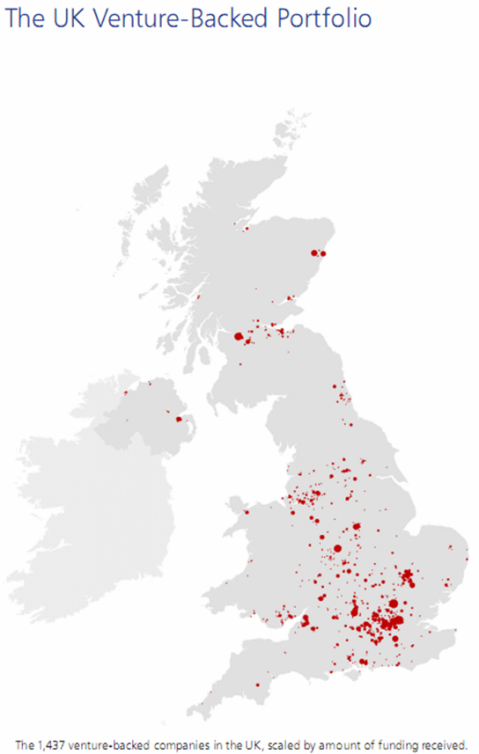
techcrunchThere is a funny article on TechCrunch UK where Nicola Robinsonova asks where the most isolated start-ups in the UK are. Well, I don’t know about start-ups, but I know about VC-backed companies. This is a map that Peter Lahoud, Stephen Siard and I made in 2006 when we were still at Library House:

I can see companies (for those of you from outside the UK, I have added additional comments in brackets) up in Scotland (very dark, rains very often). And at the West coast of Wales (yup, this is the places where it always rains). There are some at the tip of Cornwall (in the South West, where the wind never stops). And some at the East coast of East Anglia (Peter once lovingly referred to it as Dragon land, don’t ask).

Conclusion: they are everywhere. Must be some sort of unstoppable force… 🙂

AddThis Social Bookmark Button Subscribe in a Reader Subscribe by Email