Start-ups & Economic Cycles

I recently stumbled across a website called CyclePro Outlook. On this site, Steven Williams analyses various long term cycles using various chart tending packages. What really got me was the following chart of the US house prices (in Florida) over the last 60 years or so:

House price


Obviously, the crash of the US house market is a pretty big topic right now. However, what interests me in the context of this blog is the following. How should start-ups, particularly those that are not cash-flow positive react to the current situation? How do you actually react or position yourself in the case that the house market continues to drop further? Let’s assume for a second that the US continues to be in a recession or will have only marginal growth state for many quarters to come. So, what do you do?

Interesting question. A few weeks back, I read an article by Marc Andreessen, founder of Netscape (amongst other things). Well, his newest company, Ning, has recently raised an amount of money much larger than what they actually needed. Marc explains why in his blog post:

We have raised about $60 million net in a private Series D equity round”

“We raised the money to enable us to keep scaling given our accelerating growth […] and to make sure we have plenty of firepower to survive the oncoming nuclear winter. At current growth rates, we don’t need it to get to cash flow positive, but having lived through the last crunch, it’s good to be conservative with these things.”

When Marc Andreessen believes there is a ‘nucleare winter’ coming and prepares by raising extra cash, start-ups should notice. Better dress warmly. This could be a cold one.

AddThis Social Bookmark Button Subscribe in a Reader Subscribe by Email

Related articles

Zemanta Pixie

Is Facebook the Database of Un-intentions?

Facebook logoJohn Battelle once called Google the ‘Database of Intentions’. What he meant with that was that Google tracks the search terms that people type into its search engine. It catches what they are looking for on the web. Their intentions in other words, hence the ‘Database of Intentions’. It is precisely for this reason that Google works well for advertisers. Searchers have the intent of searching for something. They express their search by keyword and advertisers can bid for these keywords. Thus, advertisers get highly specific traffic directed to their websites at a fair price.

Let’s have a look at Facebook by comparison. As reported by TechCrunch, FlowingData ran an interesting article a few days ago, which showed the sort of applications that are available to Facebook users. Applications are provided by 3rd party developers and Facebook allows them to operate these applications on their platform. In a sense, the type of these applications gives a very interesting insight into the intent of Facebook users. Most interestingly, the vast majority of applications are classified as ‘just for fun’, followed by gaming. Those familiar with Facebook will understand what ‘just for fun’ means. These are all the vampire kisses, hugs, pokes and so forth. I can assure than when you get ‘bitten by a vampire’, there is no serious intent involved.

Today, I read an article by Bob Gilbreath. Bob is a marketing executive who reported on his experience of using Facebook as an advertising platform. Bob’s conclusion is damning. His results for both CPM (cost per impression) and CPC (cost per click) are below industry average, both for targeted’ groups within Facebook and for Facebook as a whole. You can read the whole and well written analysis on his blog. To sum it up: advertising on Facebook in his experience was worse than on any other normal website. Facebook is less effective than the industry average. This impression seems to be mirrored by others whom he refers to, including Chris Anderson, Fred Wilson and Nick Denton.

Wow. Worse than average? How is that possible? Isn’t the theory that social networks are supposed to be highly specific and effective in terms of the kind of traffic that they can send to advertisers?

I still believe that to be true. So maybe this was a Facebook specific problem? Thinking about this, it suddenly hit me. Facebook is the place where people go without any specific intent in mind. This is shown clearly by the kind of ‘just for fun’ applications on facebbok. Facebook users simply go to fool around, ‘just for fun’. Thinking back to Google’s, as John Battelle expressed it, ‘Database of Intentions’, maybe Facebook is the opposite of Google. Maybe, Facebook is the Database of Un-intentions.

If this rationale holds water, then this must make Facebook’s traffic the opposite kind of traffic to Google’s traffic. Given that Google’s traffic is the most valuable of the web, this would make Facebook’s traffic the least valauable. This could explain why advertisers seem to get such a low return on their money at Facebook.
AddThis Social Bookmark Button Subscribe in a Reader Subscribe by Email

A Good Reason to Like Microsoft Live

Having just returned from holiday in Portugal (very nice, by the way), I read about the fact that Microsoft live has received a face lift in the meantime. I thought I should check it out.

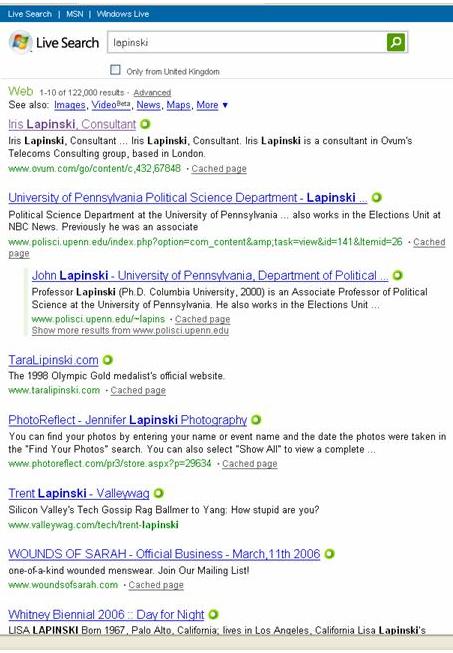
I was amazed. Not by the layout, but by the search result. The search for my family name – Lapinski – returned ca. 122,000 results. And my wife is in first place! 🙂 Well done Microsoft!!

Microsoft Live

AddThis Social Bookmark Button Subscribe in a Reader Subscribe by Email