VC Fund Raising Manual – 4 The Pitch

People attribute a lot of importance to the pitch. I guess most people believe that if they give the ‘perfect pitch’, the VC will invest in them. I doubt very much that this is true. The reason for this is that VCs are much better at analyzing pitches than founders are at giving them. It is not so much in how well you pitch, but what you pitch that will determine the outcome of your first interaction and whether you progress to due diligence.

Overall, there are two aspects to pitching: how you pitch and what you pitch.

How you pitch means the way in which you construct your presentation, number of slides, topic of each slide, the order, the kind and amount of information on each slide, how you stand when you pitch, how you use body language, how you use your voice, where you place the emphasis etc. These are generic skills that you will need in business life. If you are inexperienced in giving presentations, then I suggest you take a course where you learn how to do that (seriously). I took one a few years back, very interesting and useful stuff. In terms of the presentation that you should put together, have a look at my previous post here.

What you pitch is far more important then how you pitch. In order to understand what to pitch, you need to understand what VCs are looking for. This is what this article is about.

At a top level, there are only a few considerations that VCs have when they are looking at an investment opportunity. Most people will tell you that VCs are evaluating the following aspects:

Market: Is this an interesting market that the company is addressing?

Product: Does the company have a compelling product that can address the market well?

Industry: Can the company compete effectively in their space and is there a good exit opportunity for them?

Technology (this links to both product and industry): Can they leverage technology to produce a product and does the technology give them competitive advantage?

Financials and business model: Do they make sense?

Team: Can they execute the plan well?

Investment case: Is this a compelling opportunity to make a lot of money?

The above is completely correct. If you have all these bases covered, you probably have an investable company. However, this is not all for which VCs are looking. In order to understand what VCs really want, put yourselves in their shoes. A partner at a VC firm makes ONE (1) new investment per year (meaning an investment in a company that they haven’t invested in before). So, you are asking the partner the following: “Ignore all the other deals that you are seeing right now. I am offering you the best opportunity to invest in. I am by far your best shot this year.”

A VC that I talked to last year summed this up very nicely: “Most entrepreneurs don’t understand that the thing that they need to do is make me clear my desk for them. They must make me believe that right now, this is the best deal that there is for me. They must manage to rise to the top of the pile.”

How do you get to be top of the pile? I am going to try and explain this by example. Imagine you’re a VC. A founder walks into your office. She gives you the following pitch.

Version 1: “Hi, nice to meet you. I am doing this great company that has incredible potential. Have a look at this great pitch. We are raising $5 million. We think we will give you a great return on your investment. Say five times in five years. And we will be great fun to work with, we have a great team. What do you think; are you interested in taking a look?”

So, what do you think? Does it sound like a great proposition? Let’s have a look what other people sound like when they pitch to the same VC in the same week.

Version 2: “Hi, we haven’t met, but you know Bill. As you know, I have worked with Bill in the past and we made a lot of money together. I am now raising money for my new company and I wanted to ask you whether you would be interested in taking a look at it?”

Sounds better, doesn’t it? Here is an even better pitch.

Version 3: “Hi, we haven’t met, but you might have heard of my company. It is going great. There are quite a few reference customers you can ask about that. Really, our users numbers are going up drastically right now. Are you interested in taking a look?”

And here is an even better pitch.

Version 4: “Hi, how are you doing? Remember the money we made the last time we worked together; I still can’t believe me managed to make that much! Listen, I am doing this new company. This time, we are really swinging for the fences! Our old friend Bill has already put some seed money in. I have also started working with the customers who bought from us last time, they are very interested and we have started ramping up some strategic sales. Our early user numbers are looking great. I am now raising a Series A round. Are you interested in taking a look?”

If you were a VC seeing all the above pitches in one week, which deal would rise to the top of your pile and which one would be at the bottom of the pile…?

There are two things that tend to positively influence any investor: trust in the people who run the company and objective proof of the (beginning) success of the company. The more a VC has reason to trust you and has access to evidence that your company is successful, the more you rise to the top of the pile. For the consultants amongst you, think of it as a two-by-two:

VC criteria
VC criteria

That is the ‘what’ of the pitch. Of course you are pitching a company that is addressing an incredible exciting market, has great products, powerful technology, a fantastic team and offers a compelling opportunity to make money. If you didn’t have this, you would be in the VC’s office in the first place. But really, what you pitch is that you are a trustworthy person who can already demonstrate that this company will be a great success. If you can do that, you are likely to progress to the next stage which is due diligence.

VCs are not risk averse. They simply invest in the best opportunities they can find. Or would you invest in anything else, if you were a VC given the choices that you have? Exactly.

Index of VC Fund Raising Manual can be found here.

AddThis Social Bookmark Button Subscribe in a Reader Subscribe by Email

Zemanta Pixie

Why is Facebook worth more than Yahoo?


Mike Arrington at TechCrunch published a ‘valuation metrics’ for social networks yesterday. Read the whole article here.

What struck me is that somehow Facebook seems to be getting a significantly higher valuation than companies with comparable business models, for example Yahoo. How can that be right?

Let’s take a step back and think this through. The valuation of a company corresponds to its ability to generate revenue, to do so profitably, being able to grow fast and have a high probability that the revenue is not going to dry up soon. All this depends on a company’s business model.

As far as I am aware, there are only a few ways in which you can generate revenue on the Internet. Each of these revenue opportunities converts usage into money. Different business models are doing so at different rates:

Business Model

…version with notes:

Business Model

Using this (admittedly very rough) estimate, we see that Search is a superior business model in terms of converting traffic into revenue.

Taking a cut of a real world transaction (eBay) also converts traffic well into cash.

Premium subscription and advertising work equally well, both at some 1/3 of the efficiency as Search.

Back to the original question: how is Facebook running a different business to Yahoo and why should Facebook be able to command a premium valuation above and beyond of Yahoo’s? They are both mainly display advertising-based businesses.

At best, Facebook can command a valuation that is in line with what companies like Yahoo can command. I have read many reviews where people criticised Facebook’s advertising programme, but let’s leave that aside for the moment.

Yahoo’s market cap today is some $30bn. If we (roughly) attribute half of that to its search business and overseas activities, then the market cap based on US display advertising would be roughly $15bn. If Facebook can generate some ¼ of Yahoo’s traffic, and if it has some 50% efficiency of converting traffic into revenue, then it should have some 1/8 of Yahoo’s value. (Maybe slightly higher, if you take into account that Facebook is growing rapidly. Maybe slightly lower, if you take into account that Facebook is not profitable.) Let’s say that is $2bn.

Unless Facebook (or any of the other social networks for that matter) can come up with a better way than display advertising to monetize its traffic, then the way in which it should be valued shouldn’t really be different from the way in which Yahoo is valued.

What is remarkable about Facebook is not its amazing ability to convert its traffic into revenue (it is not a Google). What is amazing is how quickly it managed to grow its traffic. It grew from nothing to 35 million users in four years. Now that is amazing and that is the real strength of social networking. You can grow a great business in a very short period of time. But the monetization is still dependent on the display advertising business model. I guess you can’t have it all.

AddThis Social Bookmark Button Subscribe in a Reader Subscribe by Email

Zemanta Pixie

VC Fund Raising Manual – 3 The Approach

How to approch a VC firm is pretty important. There are three aspects here: whom you approach, how you approach, and when you approach.

Whom to approach

At most VC firms, there is usually only one/maybe two people there that you really want to talk to. That would be the General Partner at the fund who invests in companies like yours.

VC firms usually uperate as partnerships. The General Partners of the firm (GPs) employ further support staff, some of which are on the investment side, such as Analysts, Associates, and Investment Managers, and some of which are further support staff.

The key to approaching a VC firm lies in understanding that the GPs will make a group decision as in which companies the fund will invest. Everybody else in the firm can and does influence decisions, but they don’t get to make them. The GPs of a fund will make that decision.

They key to getting VC investment lies in convincing one General Partner to support and lead your deal. It is then this partner’s job, with your strong support, to convince all other General Partners in the fund to invest in you.

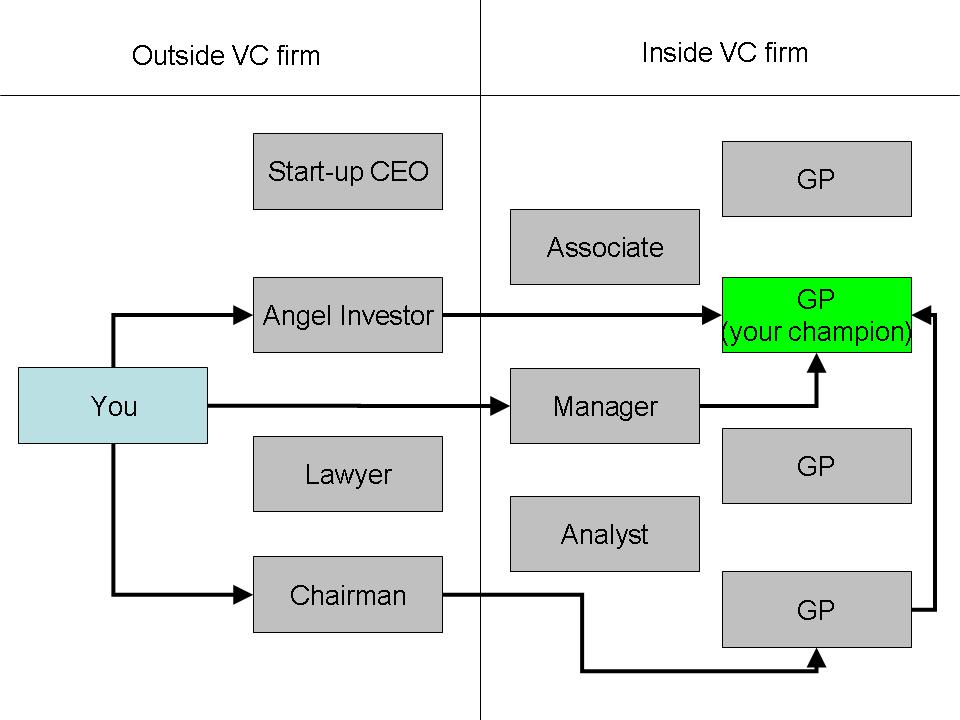
Let’s use an example to illustrate how this would usually work. Let’s assume there is a VC fund with some 6 General Partners. One partner invests in mobile companies, two in semiconductors and IT system, and three in software and Internet services (this is not an unusual distribution). If you are a mobile (phone) related company, you probably need to convince the partner who makes these kind of investments to champion your deal. Once you have convinced that partner, he/she will then, over the period of due diligence, convince herself/himself and everybody else that this is the best deal he/she can champion this year. Your (now) champion will put forward the proposal to invest in you. Typically, all other GPs need to consent. Many firms operate on the basis that if one partner thinks it is a bad idea to do a deal, then it won’t happen. In any case, the only person in a fund who can actually convince ALL partners to agree to do the deal, is one of the General Partners. If you can’t convince that one partner, there will be no deal.

Going back to the list of VCs that you created initially, where you identified VC firms who actually have the ability to invest in you, you now need to identify the partner at each firm whom you need to convince. You need to pitch to that potential champion. Unfortunately, it isn’t quite as easy as this:

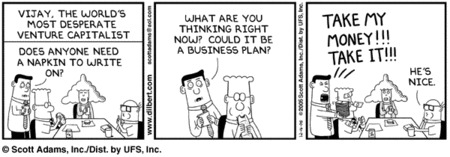
VC comic

How to approach

For all the funds that you want to approach (based on whether they can invest in you and haven’t invested in a competitor, yet), note down the name of the relevant partner. The best way to connect to that partner is to get a personal introduction to that person. Scour your address book. See whom you know who might know that person. Chances are, if you get a personal introduction and if you have a well written teaser document, then you will get invited to pitch.

Pitching to Analysts, Associates, Managers, Venture Partners or GPs with a different focus is a great opportunity. They can give you an introduction to the partner(s) that matter to you. If you have to pitch to them to get to the GP in question, then take the opportunity, but if you do, don’t believe you have actually already pitched, yet. All you have achieved is getting on step closer to the GP that you really want to pitch to.

If you find it difficult to get in touch with VCs, you may want to bring somebody onboard either as an angel investor, or advisor/director who is well connected and who can make these introductions. Other ways are to attend many of the small (and free) networking events, where you can get to know people. There are also events specifically for VCs where you might sneak in (it is good fun). Many VCs blog, you can start talking to them online. Or you could get to meet them on online social networks.

Find VC

There are many ways to get in touch. Ultimately, the route doesn’t matter. What matters is that you pitch to the right partner.

When to approach

There are two parts to this. First, remember that you had identified VC firms who don’t have any new funds, so can’t really invest in you, but still would like to see you pitch, so that they remain in the deal flow? Pitch as few of these first, say 2-3. The people there are no less smart than the guys at any of the other funds. They will flush out any problems that your pitch might have.

Once you have practiced and refined your pitch, it is time to approach your real prospects. I think it makes a lot of sense to line up the approach to all the VCs that you care about, and then to execute them simultaneously. I am no the only one thinking this, by the way. Approach all these investors at the same time. The reason for this is as follows: unless you do this, you won’t have several term sheets from interested investors at the same time. And unless you are in that position, you won’t be able to compare them. Comparing term sheets is important not so much for playing investors against one another (which is very hard to do unless you have been around for a long while), but it will tell you what your value in the market really is. It will also tell you which terms you won’t be able to negotiate away and which ones are really unusual or which ones are borderline (at that time in the market place). Once you receive a term sheet from an investor, you may have some two to three weeks to negotiate and decide whether to sign it or not. If you stagger your approach of VCs over several weeks or months, you are extremely unlikely to have multiple term sheets at the same time. This will disable you from understanding your market value and that will likely result in a deal that is less optimal then it could have been.

Pursue a number of well qualified VCs prospects you can manage simultaneously (say 10-20) and approach them all in the same week. Then take it from there.

Summary

  • Identify the relevant partner(s) at a VC firm
  • Find various approaches to get introduced to these partner(s)
  • What you want is to pitch to these partners. Nothing more, nothing less.
  • Approach a small number of investors who can’t invest in you first and practise and refine your pitch.
  • Approach a solid number of well qualified prospective partners simultaneously, so you get to term sheet stage simultaneously. Do not stagger your approach.

Index of VC Fund Raising Manual can be found here.

AddThis Social Bookmark Button Subscribe in a Reader Subscribe by Email

Zemanta Pixie