VC Fund Raising Manual – 5 Due Diligence

When you have successfully pitched to a VC, the next step is due diligence.

This article is part of a series, you can find the Index of the VC Fund Raising Manual here. Answers.com says that due diligence can be understood to be:

“Generally, due diligence refers to the care a reasonable person should take before entering into an agreement or a transaction with another party.”

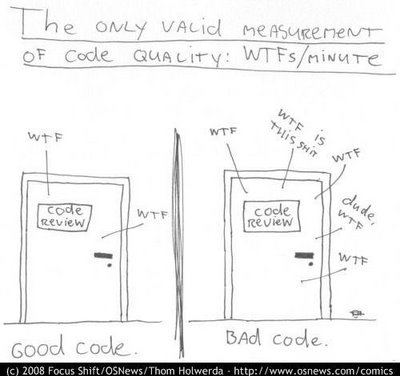
For the hackers amongst you, due diligence is similar to code review, but for companies:
code review
code review

Most deals, M&A as well as investment deals, are done on the basis of several different types of due diligence:

– Commercial: looks at business environment of the company

– Financial: is concerned with the financial forecasts of the company

– Technical: looks at the technology of the company

– Accounting: looks at the accounts (or the financial ‘past’ in other words)

– Legal: looks at legal agreements and legal risks

In a VC deal, the investor would usually conduct the due diligence in the order that I have outlined above. When you are entering due diligence, the VC will clarify who will work on the deal. This is usually a partner who is supported by an Associate.

In a first step, the VC will talk to existing or potential customers, as well as industry specialists about your company to confirm that the company has a strong commercial position. In the vast number of circumstances, a VC will not hire an investment bank to help with the financial due diligence, but she will look at the numbers herself. There will be a lot of questions regarding the business model and the financial forecasts that you will have to be able to answer. Depending on the technical background of the VC, she would either conduct technical due diligence herself, or, more frequently, she would ask an expert in the field (e.g. a professor) to take a look. There will be various requests for documentation from the VC and the technical expert throughout the due diligence process.

Once the VC is really happy with the commercial and financial prospects as well as the technical underpinning of the company, the next step is Full Partner Presentation and if that works well, a term sheet.

It is only after you have signed an exclusive term sheet that the VC will start to conduct accounting and legal due diligence. The reason for this is simply that these two steps are very cost intensive. The VC wants to have the knowledge that they are very close to doing a deal before incurring these expenses. Also, a term sheet has one binding aspect: you, the start-up company, will have to pay the costs of the due diligence when the deal completes. You may not necessarily have to pay the costs of the due diligence when the deals does not complete, but that depends on how well you negotiate the term sheet. To be clear: you will almost always have to pay the VC’s due diligence cost, if the deal completes. Should the deal not complete, then as a minimum, you obviously have to pay your own expenses, but you still may have to pay the VC’s costs, too, even when they end up not investing, unless you have managed to negotiate that part of it away.

Due diligence pre Full Partner Presentation usually takes some 8-12 weeks. During this period of type, you will have some very extensive contact with the VC firm and will be talking to them on a very regular basis (say 2-3 times a week). There may be several meetings with various people to discuss various aspects of the company and the deal.

Overall, this phase is there to solidify the original impression of the parter that this is an interesting deal. The partner is trying to poke holes in your story. It is your job not to let that happen. For you as a founder/manager, this is a great opportunity to get to know the people at the VC firm and understand whether you think you can work with them going forward.

As a side note: I strongly suggest that you use the time during which the VC does due diligence on you to do due diligence on the VC. By far the best way to do this is to talk to current and past CEOs who have taken money from the VC firm. You want to understand how the individuals at the VC firm reacted when the going got rough at a company. Were they supportive or did they just fire the management and put somebody else in? Or when a company received an offer to get acquired for only 2x money invested, how did the VC react? There are many questions like this that will clarify whether the partner and the VC firm in general seem like a good fit.

I suggest you do this when you are in due diligence, as you will have little time to do this in the next phases which are Full Partner Presentation and Term Sheet.

The Index of the VC Fund Raising Manual can be found here

AddThis Social Bookmark Button Subscribe in a Reader Subscribe by Email

Viral Video Code

Yesterday evening, I had a look at a few dozen ‘viral’ videos and realized that there is a reasonably simple code for constructing them:

(funny AND/OR sexy AND/OR cool) AND surprising AND absurd

What led me to this thinking was a link by Seth Godin to a review of various ‘types’ of viral videos. There are some 21 categories of viral videos in this review. I had a look at pretty much all of them and then went to YouTube to have a look at the characteristics of videos with many views. Like this one:

[Youtube=http://www.youtube.com/watch?v=qg1ckCkm8YI]

Looking at all these viral videos (like the one above), I started thinking that there are three elements to all of them:

– I must like what I see and think other people will like it, too (The ‘Yeah!’ factor)

– I must be surprised by the video (The ‘What!?’ factor)

– I must think the video to be (at least slightly) absurd (The ‘No way!!’ factor)

In the simplest way, I must think: Yeah! What!? No Way!! If I do that, then I am likely to forward the video. In some more detail.

Funny/Sexy/Cool -> Yeah! Factor

All viral videos I have seen so far either have at least one elements of ‘fun’, ‘sex’ or ‘cool’ or any combination of the three. I guess these are the three things that we all enjoy and and that we all want to be seen as being. Who wouldn’t want to be cool, sexy and funny…?

Surprise -> What!? Factor

There are many videos in the world. Even a lot of funny ones. But unless they surprise us, they don’t stand out. This makes us look up and really notice a video. Surprise as an emotion also intensifies the other three preceeding emotions.

Absurd -> No Way!! factor

There has to be an element of wanting to share the video. I think this is the absurdity factor. Or the disbelief factor. This is our excuse to forward a video: “Look at this, no way!” It helps us distance ourself from the video, so we don’t look silly for forwarding it.

Overall, I can find this pattern in each viral video I have looked at so far. Now, for the pro’s amongst you, I am sure you can find many good ways of creating videos that are:

(funny AND/OR sexy AND/OR cool) AND surprising AND absurd

In order to understand how to go about it, check out some additional categories in the review that I mentioned before. Good stuff.

UPDATE:

The above doesn’t just apply to videos, but to all forms of media that can be shared online, like presentations:

AddThis Social Bookmark Button Subscribe in a Reader Subscribe by Email

Zemanta Pixie

Google Trends is Behind the Curve

Google Trends is sometime heralded as a tool that can help to predict the outcome of future events. I have said before that I think this is unlikely to work, and from what I found today, I believe this even more so.

Today, I stumbled over an article that Anne Zelenka wrote some 9 months ago at GigaOm. In this article, Anne refers to a CNET article that described how Marissa Mayer stated that based to Google Trends, Hillary Clinton was likely to win the Democratic Party’s nomination. We all know how accurate that turned out to be…

Here is the Google Trends graph from that article in GigaOm:

So, today, I went back into Google Trends to extract a more granular graph from January 2008:

Obama Hillary
Obama Hillary

As you can see, until January 3rd, the date of the Iowa Caucus, Clinton and Obama had the approximate same number of Google searches. Once Obama had won in Iowa, his searches skyrocketed and he left Clinton behind for some five days. However, on the day that Clinton won the New Hampshire Primary, Janury 8th, they were neck to neck again, until the 26th Janury, when Obama won South Carolina, at which point he started to build up a lead over Clinton again.

In all three cases, there would have been no way to use Google Trends as an accurate tool to try and gauge who will win the next primary/caucus. However, in retrospect, you can actually see who the winner was from looking at Google Trends.

What this means is the following: This means that Google Trends is always behind the curve, not ahead of it. The reason for this is that people can only search for terms, when they already know of them. They can only know them, when they have heard of them from somewhere else.

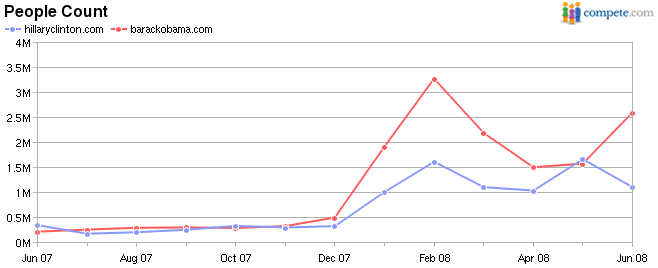
A much more meaningful tool to predict what will happen is fundamental data that you take from websites themselves. Have a look at the visitor stats of Obama’s and Clinton’s websites:

Clinton Obama
Clinton Obama

You can easily see how Obama was separating from Clinton in December 2007, he seems to have had roughly twice her web traffic and he maintained that 2x lead for several months.

I suggest that if you want to see how a candidate is doing in the online world, have a look at basic data, such as website traffic. Using basic data from websites enables you much better to understand who is going up and who is going down than Google Trends.

AddThis Social Bookmark Button Subscribe in a Reader Subscribe by Email

Zemanta Pixie