How to write a good newsletter – Part 1

Why are there so many poor newsletters? The other day, I had a look at how many of the newsletters that I receive I actually like. I grouped them into three groups:

a) the ones that I really like – 23%

b) the ones I feel indiffierent about – 23%

c) the ones that I think are downright useless – 54%

I then unsubscribed from half of the newsletters that I was receiving.

What makes a good newsletter? I had a look at the ones that I liked and didn’t like. In short, I found only three newsletter formats that worked and one that was really a waste of time. The three formats that worked were:

1) You care about X, here are some special time limited deals

2) You care about news on X, here is ALL that you need to know in one view

3) You care about X, here are some X that you may have never heard about and that might interest you

There are some great newsletter that manage to combine several of these three aspects.

The worst newsletters are the bland corporate ones: ‘We thought you would like to know what has just happened at our company’. Ah. NO.

These kind of announcements should be somewhere on the news section of the corporate website, so that people who care about recent developments can get an impression, but they don’t belong in a newsletter. It is likely the only person who cares about your company is you. People who read newsletters care about the things that they care about, not your company (unless you are Apple of course).

In a small series of posts, I will have a look at the most interesting newsletters that I can find.

Let’s start with the limited deal format.

One of the best newsletter I have ever had the pleasure of subscribing to is sent out by WineDirect.co.uk

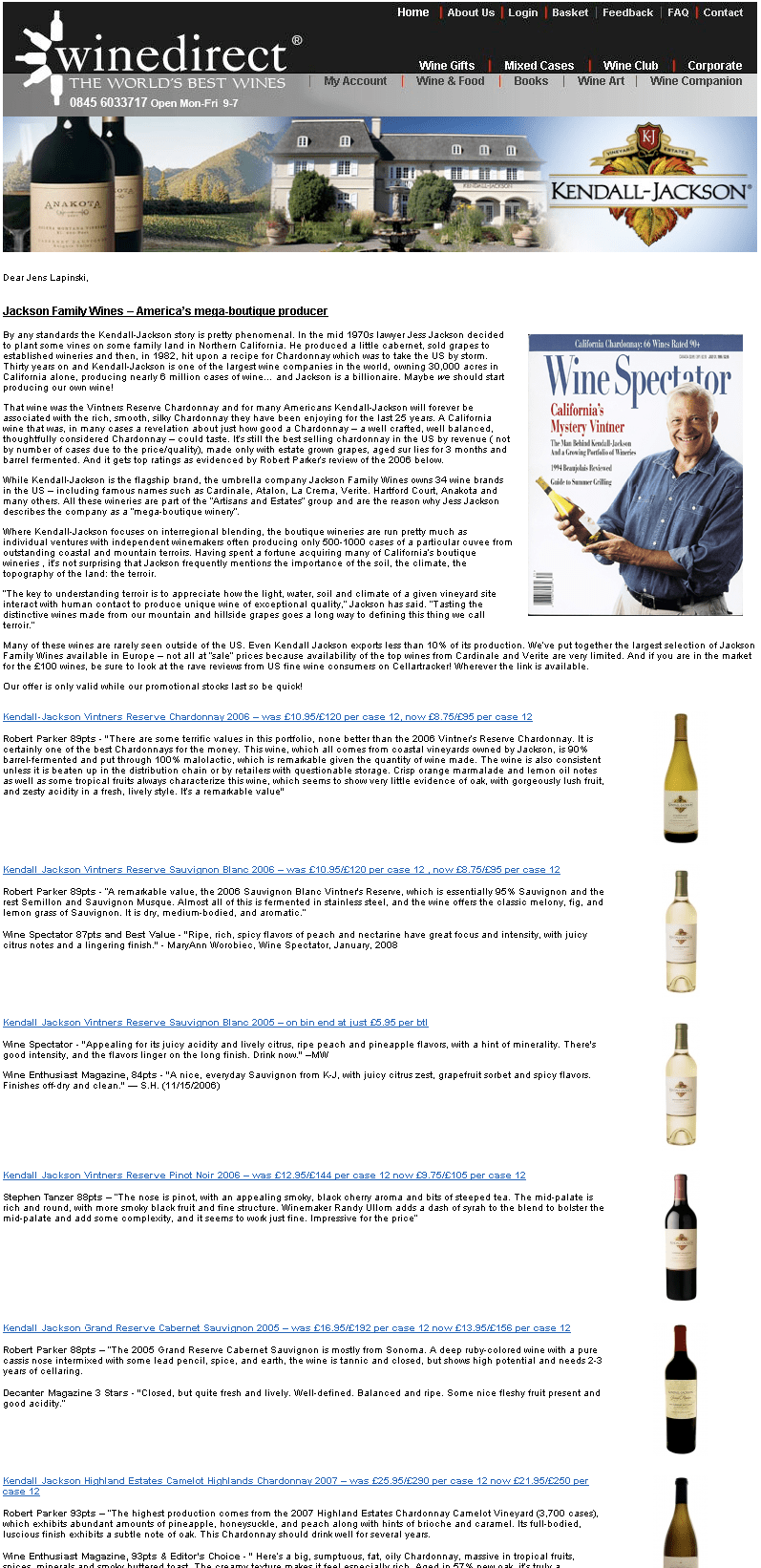
WineDirect is a UK based online wine shop. below, I have copied in a screen shot of their weekly newsletter:
winedirect newsletter

WineDirect combines several elements in their newsletter that work very well. First, they introduce you to a different winemaker every week. There is a pretty in depth description of the work of the wine maker that is genuinely interesting. Second, it lists several of the wines by that wine maker. These wines are available at a discount for one week. Each wine is described in detail with tasting notes, tasting scores, and the price (both original and discounted) which give me an immediate idea whether one of these wines might be of interest to me. Clicking on one of the hyperlinks takes you to the online page of the specific wine. Third, nothing else clutters this newsletter. It is all about the weekly special deals.

Overall, this is an exceptionally well made newsletter. I read it with interest every week. There are three reasons that I found why I read it:

1) It is genuinely interesting for somebody with an interest in wine

2) There may be some special deals in here that I might be really interested in

3) It doesn’t ‘push’, it isn’t loud. It is trying to be genuinely helpful.

Great stuff.

Part 2 of this series can be found here.

AddThis Social Bookmark ButtonShare this article Follow this blog

HitCompanies

The blogging abstinence is over. After having focussed for the last few months on launching the first web app of my company aiHit, I am now able to focus on some blogging again.

Some background

aiHit, the company that I co-founded, has recently put live a web app called HitCompanies.

HitCompanies is a database of the world’s companies.

This database of companies is automatically assembled from the Web by our intelligent Web crawlers. This involves a substantial amount of artificial intelligence and machine learning technology.

It is our vision that at some point, all companies in the world will have a presence on HitCompanies. So, if you want to find companies by what they do, so you can do business with them, you will be able to find them here, quickly and easily.

The current IT beta of HitCompanies contains some 400k IT companies and we intend to roll out across an increasing number of industry sectors over the coming months. The landing page of HitCompanies looks as follows:

HitCompanies

We are assembling structured profiles of companies in HitCompanies. An example screen shot is shown below. Again, all this information is collected and structured automatically by our bots.

Borland

Over the coming months, there will be many changes on HitCompanies, as we grow, expand and improve the app. News on developments of HitCompanies can be found on our corporate homepage’s news section: aiHit News.

AddThis Social Bookmark ButtonShare this article Follow this blog

News without Editors

I am happy to pay for news. I am not happy to pay for a newspaper. Why won’t anybody take my money?

Some good articles on the future of selling access to news have got me thinking. What is the future business model of news reporting? What is broken right now?

The Past:

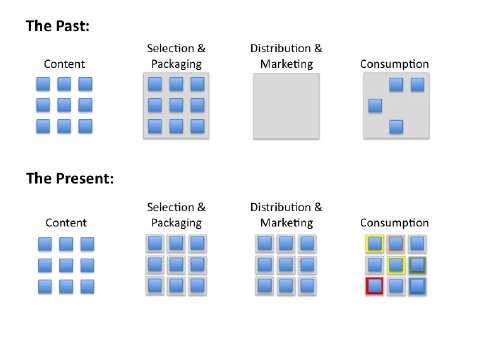
The distribution was via paper. Editors bundled a lot of stories together, printed them and sold access to the printed edition. Later came broadcast radio and television, using similar principles. Advertising plays a critical role, too. We, the consumers, paid for a combination of editing, the content, and the delivery.

Now:

Bundling is dead. Digital publishing, search, RSS readers, hyperlinks across platforms, suggestion tools (Memes, Google News etc), news pointing tools (Twitter, Facebook, etc) and so forth mean that I pick the individual articles that I read. I don’t care whether it is written on a blog, the NY Times, the WSJ, or somewhere else. I select what I read. I still read the content though, it is still just as valuable. Distribution has become much cheaper due to online publishing. No more expensive printing presses and paper needed.

The graphic below summarizes this:

news-publishingWhat this means:

I DO care about reading a PARTICULAR type of news item at a time when I decide. I DON’T care about reading a particular NEWSPAPER. I bundle my own news now. I am the editor. The job of editing for others is becoming less important. It is becoming obsolete. This is true for both print and broadcast.

In the past, we paid editors to pick the content, package it and deliver it to us. But now, we don’t have to anymore. And we don’t want to. I will not pay an editor to select my news. This is a dying part of the value chain. I also don’t have to pay for paper anymore.

However, I am more than happy to pay for the content. No problem. But publishers still insist on selling me editorial services…

Suggestion:

I am happy to pay $100+ per year to an industry organization for a subscription to all content that currently resides on newspapers. This organization could pay their members dependent on the amount of traffic that comes to their sites via the subscribers of the scheme. This would mean large and small publishers could benefit proportionally to their contribution in terms of what people actually read.

But I won’t pay for editors anymore. Not in news print, not in television. I consume on demand now. I am the editor and I decide the composition of my own, personalized news flow. My ‘newspaper’ comes for dozens of sources each day, some of which I didn’t even knew existed the minute before I read them.

When can I start paying?

Update
This video doesn’t fit the article 100%, but it is still pretty funny:

AddThis Social Bookmark ButtonShare this article Follow this blog