This weekend, I met a friend of a friend who told me that she wanted to start her own company. She asked me what the most important, or most difficult thing, in the process was. My answer was that the most difficult thing is to find customers and to make them happy. Happy customers will come back and buy more from you. They will tell their friends about you. If you can start a business with a few happy customers and grow it from there: perfect. In the second most ideal situation, you have extreme confidence based on buyer interaction that you will have customers whom you can make happy.
So how do you get to have happy customers? The basic answer is that you need a product or service that, from the customer’s point of view, is simply great. The press frequently displays these successful products as ‘an act of genius’. This is very misleading. In my experience, you get ‘great’ products when you continuously iterate and improve them. Hardly any product is great first time round.
For example, let’s take the iPod. The iPod is a result of the genius of Steve Jobs right? Wrong. The iPod was actually not very successful for a very long period of time. Over three years to be precise. Don’t believe me, look up the sales numbers on Wikipedia. The iPod was released in 2001, but it took until 2004 before the sales numbers really started to take off. There is a number of contributing reason why this is, but one is certainly the way in which the iPod had been re-iterated and continuously improved over time.
In many companies (and in the mind of many entrepreneurs and journalists), the way in which products are developed, marketed, and sold follows are more or less linear process:

There is no feed-back loop within the system, or maybe there is feedback, but the company doesn’t care about it. More successful companies operate an iterative system that uses feedback:
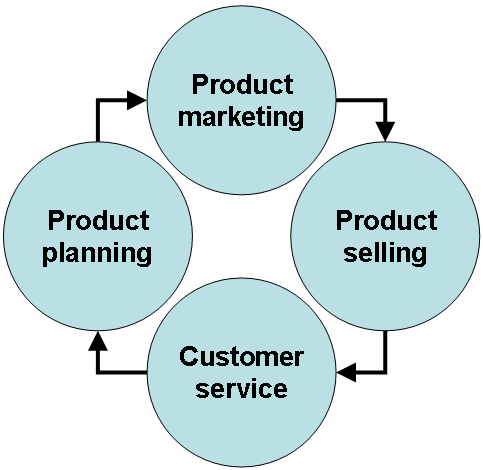
If you continuously iterate and improve your product, you will (eventually/hopefully) arrive at a point, where your product really hits the sweet-spot of the customer. Beyond that, you run into a zone of diminishing returns (see how the iPod sales figures haven’t really improved beyond 2005?).
How many iterations does it take? Depends. It took Microsoft three iterations of Windows to get to a successful product (Windows 3.1), and six to make it really work (Windows XP). It took YouTube one iteration to make it work (embedded videos and the ‘find similar’ function). It took four generations of iPods. It took 2.5 generations of the Toyota Prius (the first generation didn’t sell well at all and the second only sold after the first face lift). Adobe Acrobat needed one iteration (the free Reader).
So, back to the friend of the friend who wanted to start a company. The mistake many start-ups make is to think that they can produce a successful product without having to go through several iterations, before they actually hit the sweet-spot. That is when companies usually go bust.
In my mind, the key to successful start-up is to keep the burn-rate low, get a product out in the market, sell it a bit, spend very little money on marketing and sales, see what customers think, modify your product and then to re-iterate that process. Eventually, you will get to a point when you either hit the sweet-spot or where you don’t. If you do, then is the time to start hiring additional staff, premises etc. If you can’t find the sweet-spot after a number of iterations, it may well be time to shut down and start something new.

 It occurred to me, that in principle, customer marketing is a mislead approach. Customers don’t need being marketed to. Customer need to be excited about the product or service they are receiving. They need to be happy. They need to be delighted. The product or service should make their lives better.
 Today I have learned a lesson of how to do some really interesting marketing. I got pitched a new service by my telephone company, BT. The new service is called “BT Vision”. Somehow, I didn’t really get to reading the pitch, as it seemd to coincide with the arrival of my BT telephone bill.
 Founders View