Fast & Effective Decision Making

I read a pretty interesting book the other day called Insanely Simple: The Obsession That Drives Apple’s Success by Ken Segall. The major insight that I took away from the book was the way in which Apple apparently makes decisions. The decisions are with the people doing the work, not with those in charge.

To understand the difference, let’s think through two scenarios. The first one where people make decisions who are not doing the work and the second one, where they do.

I think the first way of decision making is the way in which the vast majority of organisations make their decisions. There is a team that is working on some project. Several people work days/weeks/months on something and then there will be an ‘important’ decision to be made. So, the team will go to their manager and say: “Hey look, we have done all the work, now we need to do X, can we please have this approved?” The typical response you will get by the  manager will be: “Well, I know very little about the situation as I wasn’t involved. Can you please brief me?” The team will then do that. At the end of that briefing, the line manager will say: “Okay. I am still not sure, I need more data to be able to make a decision, can you please do X and Y and Z.”

There is nothing wrong with this. Nobody who is not involved with something can make meaningful and quick decisions about those things. What they need to see is lines of progression, not dots. This simply takes a long time.

The consequence of this is that typically decisions that are made are suboptimal and they take a very very long period of time until they are made. This may well be completely natural, but it is also highly inefficient.

Consider the second scenario where the decision maker is part of the team doing the work. That person will have seen the progression from the start. They are intimately involved with all aspects. They know what decisions should be made. Imagine in that scenario that person makes all decisions, and their manager functions as a coach/mentor/advisor. There are regular catch ups where decisions are reviewed before they are made. Some superficially, some in detail. For example, the manager could request that the person making the decision justify their decision in writing in a multi-page Word document or similar. Interestingly, Amazon do something similar. The point here is simply to make sure the decision maker has thought through the implications of the decision and there is a real justification for that decision. However, the manager effectively delegates all decision making to the people doing the work. What they do however is ensure that the way in which decisions are made is correct. For that, they don’t have to be involved with the work, they just have to be able to understand whether the decision is well through through.

“But what happens when people can’t make good decisions?” Well, when people don’t do good work, you try to coach them to do good work and if that doesn’t work, you have to either move them into another position or you have to let them go.

That is how Apple manages (at least according to Ken).

I find this very interesting. Sounds incredibly effective. Incidentally, this is how directors interact with CEOs. If that works, why can’t this kind of behaviour exist throughout the entire management chain? Something to think about.

Part-time doesn’t cut it

Over the last decade or so that I have spent in start-ups, I have seen many instances of part-time managers, both in the companies where I was and elsewhere. I have never ever seen this work out. Quite the opposite, it tends to be a disaster.

It is obvious that at some point a situation will arise in any business where there are so many people in a functional area, that one person has to be appointed to coordinate that group (aka the manager). However, it doesn’t seem to make any sense to appoint a part-time person when there is so much work that multiple people are required to get it done.

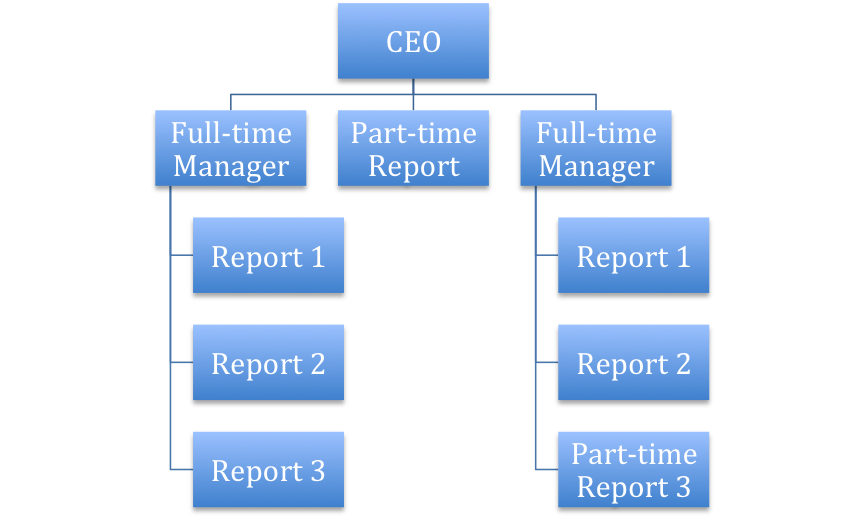
Think about it, a manager’s job is to manage the people who are working for this person. By definition this means that multiple people work for one person. Let’s depict this in a diagram.

Part-time-manager

Looking at it, this doesn’t make sense. If I have enough people to fill full-time roles, why would I appoint a part-timer to manage them?

The real world problems that I have seen arising with part-time managers are:
– Part-time managers are not in the loop, they need to be caught up with events and ‘management’ meeting are de facto catching up sessions;
– Lack of respect of the team as the manager is perceived as not lifting enough weight / working as hard as the team, or not contributing enough;
– Other managers at the same level have issues interacting with the part-timer as they are not in the office in a full-time capacity;
– The manager is not mentally as fully occupied with the company as other people in the company.

People may say: “But Jens, even Steve Jobs managed Apple part-time initially and look at what a great job he did. Clearly one can be a part-time manger and do a fantastic job!” In this situation I find it useful to figure out whether his success is a consequence or a correlation of the part-time role. My reply would be: “Was Steve Jobs so successful BECAUSE he was part-time? Or was he so successful DESPITE being part-time?”

I think the answer to that question is quite obvious. I am confident that there are individuals who are so exceptional they can overcome almost any obstacle. However, most people aren’t as exceptional as Steve Jobs was.

Being a part-time manger undoubtedly makes your job harder. Much much harder. So, why would a company want that to happen? All things being equal, does this actually make sense?

Part-time managers are not to be confused with individuals working part-time. There is absolutely nothing wrong with that. Again, let’s look at the organogram.

Full-time-manager

This looks far more logical, doesn’t it? You have a team of individuals, some of whom may be specialists or maybe you don’t have enough work for them to fill a full time role. Great examples of this are part-time accountants who do your books. Or maybe customer service reps, who only work three days a week. Other examples are individuals whom you bring in as and when needed, for example your auditors or lawyers.

So when you are working in the context of a startup trying to not die, why would you make your life harder? Why would you hire a part-time manager? In my experience, this has never worked. I think life in a startup is hard enough; there is really no need to make it any harder.

Fast 50 – A better methodology

The Fast 50 competition run by Deloitte is a great idea. You basically figure out who the 50 fastest growing technology companies in the UK are and you honor them for their achievements.

However, the current competition (in the UK) has some methodological problems. As a consequence, fast growing companies are sometimes missed, thus the list is incomplete, pundits start criticizing the whole approach and the end result is diminished from what it could be. That is a shame.

I personally have made some very half-baked comments on Twitter about this and thought I would put some more effort into suggesting some minor changes to the methodology that would make the competition more inclusive, more interesting, and more just. Here it goes.

The current approach

The Fast 50 are calculated by taking the revenues of a company, comparing it with the revenues five years later, calculating the increase in revenue, express that as a percentage increase and then rank companies according to percentage increase. Sounds great. And actually, it is not a bad approach. However, it has two problems associated with it:

1. Shooting stars are ignored. You found a company. Three years later it could have £100m revenue. You are nowhere to be seen in the Fast 50. That feels somewhat wrong to me.

2. There is a minimum amount of revenue in the first year of Euros 50k. If you have £10k in the first year, you have to wait another year. This might be despite that fact that in four years, you have grown faster than anybody else, but because your first year value was so small, you are basically ignored. Even worse, you are then forced to take your second year value, which might be £1m and as a result, you are placed far lower in the ranking than you ought to be. Again, this strikes me as wrong.

I think with some subtle changes to the methodology, both problems could be avoided.

Suggested changes

I would introduce the following subtle changes to the methodology as follows:

1) Abolish the five year period. Replace it with a flexible period of a minimum of one, and a maximum of five years. With the last year being the most recent accounting period. This allows for the accommodation of shooting stars, but will still keep long term solid growers in the race and high up in the rankings. Because you take a combined percentage amount for the rankings (not an annualised one) this should have no adverse effects on long term strong performers.

2) Abolish the Euros 50k minimum requirement. Replace it with a levelling approach. For all companies with revenues smaller than Euros 50k in the first year, replace it with a Euros 50k value. This means you always have a base to compare against and companies with £0 in the first year are not discriminated against.

A few hypothetical scenarios, let’s see what the effect would be

Scenario 1:

a) Company A posts £50k in the first year and has consistent growth of 100% year-on-year for five years. They post £1.6m in year 5.

b) Company B posts £50k in the first year, as well as the second, third and fourth year. In year five, revenue jumps to £1.6m. The company submits years 4 and 5 for consideration.

According to the current Fast 50 methodology, both companies are equal. Under the new methodology, this still holds true. Consistent growers are not squeezed out by companies with a short term boost, even when such companies use two years as the time period for consideration. However, under the suggested changes, one could state the time period and as a consequence, the achievement of Company B looks a bit more impressive, but both companies would still have the same score.

Scenario 2:

a) Company A posts £50k in the first year and £5m five years later.

b) Company B posts no revenue in year one and £5m in the second year.

Under the current rules, Company B is ignored twice. First because they don’t have Euros 50k in the first year and second because they don’t have a five year accounting period. Under the suggested rules, both companies would get the same score, as Company B’s first year revenue would be set to £50k. Again, Company B would look more impressive, as it should.

Scenario 3:

a) Company A posts £1m revenue in the first year and £25m five years later, a 25x increase.

b) Company B posts Euros 25k in its first year and Euros 5m in its second year of operations, a 100x increase (assuming a Euros 50k base for calculation purposes in the first year).

Under the current methodology, Company B is ignored. Under the new rules, Company B outranks Company A. It think this is actually the correct way of doing it. If companies get to Euros 5m so quickly, then I really want to hear about them!

Conclusion

I think there good reasons why the current Fast 50 methodology makes a lot of sense. It is objective, it is quantitative, it is revenue based. But is has some limitations. By tweaking it slightly, you stand to lose very little, but you allow for a wider pool of fast growing companies to enter, and you make it a more interesting and a more just competition. Sounds good to me.