Market entry strategy

Startup ReviewThere is a very interesting blog that reviews the history of successful start-up companies. Unsurprisingly, the blog is called Start-up Review. The blog is edited by Nisan Gabbay and friends. So far they have reviewed some 30 start-ups, using a consistent format for describing the successful journey of these companies. They do some in-depth research, including interviews with founders, management and staff. Companies covered include both homeruns like Facebook and boot-strapped successes such as HOTorNOT.

When reading through these company case studies, I noticed that certain themes around marketing and market entry seemed to resurface consistently. The same elements, while not present in every company, appeared over and over again in different combinations. In other words: a pattern seemed to emerge.

I spend a short time categorising the marketing and market entry strategies of the companies. The resultant effort is shown below. Please note that my analysis is based on the case studies, I am convinced that it is incomplete and it may also be inaccurate. What is more interesting than the individual companies is the pattern itself.
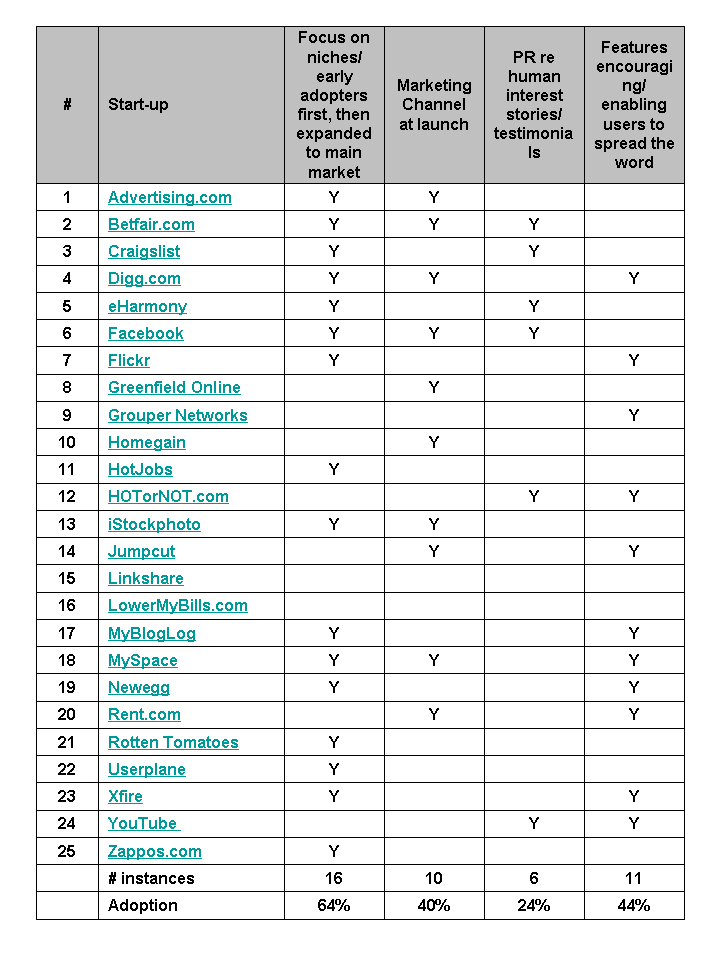
Startup Analysis

Click on the picture for a larger version.

It is probably worth noting that the absence of a control group of unsuccessful companies limits the usefulness of this analysis. For example, it is possible that unsuccessful companies deployed the same marketing strategies at market entry and failed. Nonetheless, it is interesting to see that certain types of market entry and marketing strategies are used by several of the successful companies.


AddThis Social Bookmark Button

Zemanta Pixie

Evolution and Marketing

There is a great post on Seth Godin’s blog about evolution and marketing that struck a chord with me, given my personal background in the biosciences:

    “Marine iguanas swim. IguanasThey eat stuff in shallow water, which is surprising behavior for an iguana. How is it possible for there to be marine iguanas?Ordinary iguanas washed onshore of some of the Galapagos Islands a few millenia ago and quickly discovered that eating the way they were used to wasn’t going to work, because there wasn’t anything to eat. Most of them starved to death. A few, though, were lucky enough that they could tolerate foraging around on the edge of the ocean. Over generations, iguanas with this trait thrived, while those that were born without it died out. A new species evolved.The interesting lesson for marketers is this: if iguanas had had predators and competition while this was going on, they never would have survived. The barren nature of their marketplace gave them the time they needed to evolve (or as marketers with egos would say, “figure out”) a strategy that worked.Too often, marketers are drawn to the hot market. The problem with the hot market is that if you don’t get it right quickly, you get crushed. Really big ideas tend to get perfected in the Siberian outposts, the little niches that get ignored (until they get really big). It takes a lot of confidence to walk into a hyper-competitive market with something new. Quieter markets may just give you the cover you need to work out what it’s going to take to make those marketers grow.”

I think the principle notion is clear: when you move into a competitive environment, also known as ‘red oceans’, you have to fight for survival. It is probably preferable to move into a ‘blue ocean’, with little or no competition. In an ideal world, this ‘blue ocean’ grows rapidly over time, resulting in good company growth. This concept of red vs. blue oceans was developed by two INSEAD professors who have written a very interesting book about it, Blue Ocean Strategy, that I can recommend.


AddThis Social Bookmark Button

Zemanta Pixie

Pragmatic Webinars

WebinarOne of the most interesting sources of content covering product management and product marketing topics is a webinar series by Pragmatic Marketing. The series covers a myriad of topics related to product management on marketing more generally. One of my favourites is a recent Webinar held by David Meerman Scott on the ‘New Rules of Marketing and PR’. Scott has also published a book of the same title which I haven’t had the chance to read, yet.

Scott’s view on Internet marketing in general can be summarised with his belief that ‘You are what you publish’. So, for example, if you have a website that takes a long time to load just to show you TV commercials of the company, then you are slow and boring. If, however, you have a website that has cool content on racing bicycles, then you are cool and know your stuff about racing bicycles. Overall, the argument makes a lot of sense to me. Scott then gave the hilarious example of how IBM market their mainframe computers using YouTube: great stuff.

This general approach pervades much of Scott’s thinking. He extends it to areas such as press releases. For example, let’s say you publish one press release a month that contains a lot of marketing jargon. This means that a buyer has a low probability of finding this release accidentally via, say, Google and even if he found it, he would have a hard time understanding it. You are what you publish: can’t be found, can’t be understood. The opposite example was to publish releases much more frequently and to use actual buyer language in the release. This would then lead to a much better chance of somebody finding the article and then actually being able to understand it, too.

As an aside, Scott has also done some statistical analysis of the words used by PR/marketing specialists so frequently that they are essentially devoid of meaning. Top of the list of the words frequently used in press releases were: “next generation, flexible, robust, world class, scalable, easy to use” you get the gist. My personal favourite in that list is “enterprise class”.

Overall, I suggest you check out both the Pragmatic Marketing webinar series and Scott’s work, both are very intriguing.


AddThis Social Bookmark Button

Zemanta Pixie