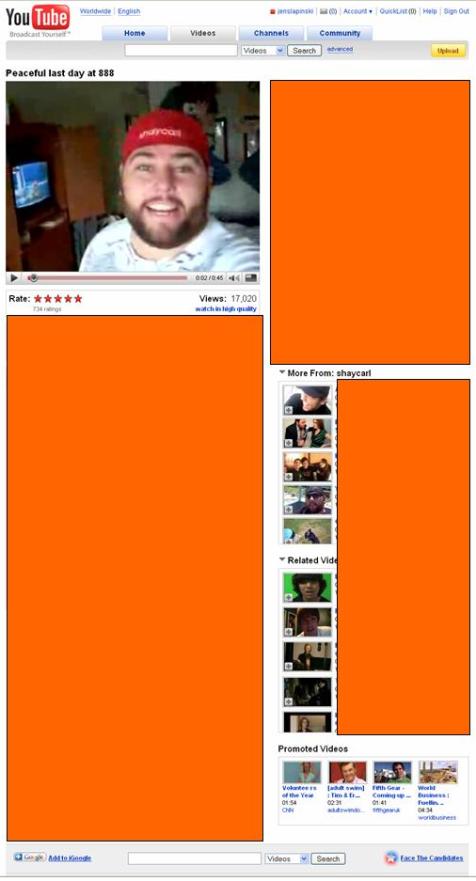
 Google has been trying to make YouTube work financially for some time. They couldn’t. Yesterday evening, I have a discussion with a friend about how to more effectively utilize the space on a website to drive people to what is truly valuable on a site. On the way back home, it struck me that YouTube is phenomenally ineffective at utilizing the space that they have. This morning, I took a quick screen shot of YouTube. I have covered all the areas with orange squares that I consider to be a waste of space on YouTube. Have a look:

I quickly measured the size of these areas. In my opinion, 66% of the space on a YouTube page is wasted. Think about it, they only use 34% of what they have effectively. They also operate a fixed width of the screen (not shown) which means I have these white bands on my monitor. Why they do that is beyond me. Even more wasted space.
The second thought that then struck me was that the following. Because YouTube is only using 34% of the space available, their entire monetization strategy is concentrated on squeezing stuff somewhere into these 34%. Guess what: that doesn’t work very well. The reason why it doesn’t work is because that interrupts the functionality of the site. You start to think along the lines of television advertising: pre-rolls, post-roles, interruptions, pop-ups, all this stuff that users don’t want.
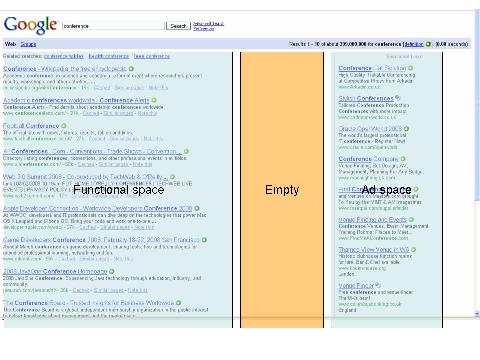
Let’s have a look at Goggle Search for comparison. One of the things that Google Search is so good at is using space effectively. I would actually argue that over 80% of the space on the site is used effectively. Have a look:

More than half of the screen is occupied by functional space (ca. 55%), then there is a spacer (ca. 20%) and then there is ad space (ca. 25%). The key insight of Google Search is that if you use more than 50% of space effectively for functionality and you fill part of the rest with things that are sponsored, and potentially useful, then you have a great money making machine.
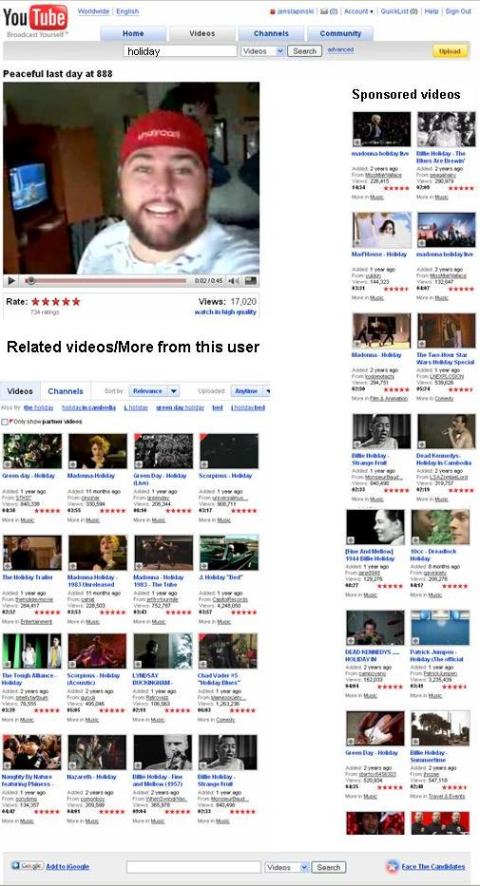
Just imagine you achieved the same use of space and the same principle of placing sponsored items next to functional elements on YouTube as you have on Google Search. You could totally change the way in which the site becomes useful and make money at the same time. I made a quick mock-up of what I mean below:

I removed all the items that I termed as a ‘waste of space’. People go to YouTube to watch videos. So I gave all the space to videos. I removed the comments. I removed the AdSense. I removed all the unecessary words next to videos (who cares what is written there, is it important, it is essential?). Below the video, I have placed more related videos (a very useful feature). I indicated you could have the ability to toggle there to the page of the creators of the videos, to see more of their videos or to subscribe to their channel (also very useful).
On the right, I have placed sponsored videos. AKA ads. In the search field above, I have indicated that the search term here is actually ‘holiday’. I am sure lots of companies would love users to watch their promotional holiday videos…
These days, companies are actually producing videos to be seen by people on YouTube. They do this in the same way in which they produce websites to be seen by visitors. These videos are then placed on YouTube and a lot of work goes into making users watch them. I am sure that the companies who spend money and time producing these videos would have no problems at all to pay Google a certain amount of money for each watched clip. After all, this would be similar to what happens on TV. You could bid on VideoWords (I just made this up, feel free to use it Google) in the same way in which you could bid on AdWords. You could also have VideoSense that places sponsored videos on the side, when somebody didn’t search by keyword, but came via a hyperlink or via a connected video. Companies could bid on the position of these videos in the same way in which they bid on AdWords.
Another useful feature would be the ability of video creators to insert a hyperlink (maybe with a maximum length) into the video that they created. What I mean with that is a hyperlink that sits in between the video and the control functions. This would allow users to follow the hyperlink, if they want to find out more about the maker of the video/the product/etc. This hyperlink should obviously be clickable:

If you had such a hyperlink, people could use videos more effectively to drive traffic to their sites. You could obviously also monetize them by charging advertisers when users followed such a hyperlink in a video that was opened from the sponsored section of the site…
So, lots of ways in which you could make better use of space and give more functionality to users and make the site more useful to advertisers. My guess is that Google will have to radically overhaul YouTube to make it work. Three years of gradual innovation haven’t gotten them anywhere. It is probably time for a major re-think.

 Subscribe in a Reader
  Subscribe by Email
![Reblog this post [with Zemanta]](https://i0.wp.com/img.zemanta.com/reblog_e.png)

 Founders View