Say Thank You to Valued Customers

This week, I found a great example of good marketing and customer relations: my landlord.
Given the uncertain housing market situation in 2006, my wife and I decided to rent, rather than buy. We just renewed our rental contract for another year (the third). 

During the negotiation around price, I gently pointed out to our landlord that we had been staying for some two years now and that there never was a problem with us as tenants. I asked him whether that was worth a discount on the price that he was asking for. He gave me 2%. I felt great about it, and we closed the deal.

This is very interesting and I took some time to think it through. 

Let’s suppose you have the choice. You can either let a house to somebody whom you don’t know, or to somebody of whom you know that they are not trouble-makers and take 2% less.

Which would you choose? Given that we all know that 5% of customers usually cause 95% of the work, this is a no-brainer.

Overall, I feel delighted that my landlord has given me a small discount. It creates a small bond between us. Particularly in such troubled times (as far as the housing market is concerned). 

Imagine companies gave discounts to long term customers who have behaved well and who haven’t caused problems. When was the last time your telephone, cell phone, gas, electricity, satellite, or any other company that you subscribe to has mailed you out of the blue and said: “We will lower your bills, because you have been a good customer?”

In my opinion, they should surprise you with it. And it would be great marketing indeed.

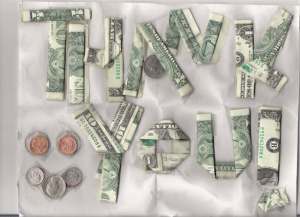
PS: Picture taken from: http://peter-hurley.com/thankyou.aspx

AddThis Social Bookmark ButtonShare this article Follow this blog

Specific marketing – target the right people

virginToday I received a promotional flier from Virgin Media in the post. I read it. What a waste of time. Virgin is trying to promote something to me that I can’t actually buy. Specifically, they tried to sell me video on demand (great!) via their optic fiber network. Problem is: I have no optic fiber connection in our house. What is worse: I asked Virgin for it and they said they couldn’t supply it to me.

Think it through slowly: they tried to sell me something of which they already knew that I can’t get it. They told me so themselves.

When you are marketing, be specific. Don’t waste your money. Or my time. Target people who can actually buy what you have to sell. Promoting something to people that they want to have, but can’t get will actually have a negative effect. I am a little angry with Virgin now. They reminded me of something that I want, but can’t have.

What I want in the post is: “Jens, guess what, you can have fiber and video on demand now! Sign up here!” I have told them in the past that this is what I want. And giving people what they want is the way to delight them. Mindless mailshots to some rubbish list won’t.

AddThis Social Bookmark ButtonShare this article Follow this blog

Reblog this post [with Zemanta]

Faster To Edinburgh with On Demand

hulu

“Jens, if you drove to Edinburgh today, would it make a difference how quickly you could open the door of your car?” I was asked this question by a colleague the other day. Given that Edinburgh is over 500 miles from London, my answer was: “No”. “So why are most established companies focusing on the equivalent of making car doors open faster?”

It took me a few days to really understand what my colleague tried to tell me.

Management and owners in established industries have a certain way to extrapolate the past into the future. The way in which products were improved in the past is the way in which products will improve in the future. But at some point, you reach a situation where improvements at the same point make no further difference to the users. And it is usually at that point that new developments will change the way in which the industry works.

Television is now at such a point in its development.

For years, TV was improved in two ways:

  1. The quality of picture and sounds was improved. First there was black and white picture and no sound. The there was B/W with sound. Then there was color TV. Then image and sound qualities improved. Now, you have Dolby Surround sound and high definition TV.
  2. More and more channels provided an increasing number of programs to watch. People can choose from amongst 100s channels these days, up from 1 when TV started.

So, ask yourself this question: would you really care if the quality of the picture and sounds doubled beyond HDTV or if the number of channels doubled? For me, the answer is a clear no. It is fine as it is. I don’t need better picture. I can’t deal with even more channels.

But what I really care about is something that TV just can give me: on demand. When I watch TV, I have to watch what other people decide I should watch at a time when they decide I should watch it. On demand means I can watch whatever I want exactly when I want to watch it. 6 billion video clips are watched on the Internet in the US every month. Of these, over 100 million are high quality TV programs, according to the Inquisitr.

There are many things that on demand will change. Essentially what it does is to make the existence of intermediaries (the TV channels) and almost everything they do obsolete. Costs to view a program will fall, as the intermediaries are cut out and producers can distribute content directly via the Internet. TV programs will get reviewed and rated the way in which computer games are rated today, because we will start to consume them like computer games. All of this is reasonably obvious to many people.

And yet, the TV industry is doing the equivalent of trying to make the opening of car doors faster. They are betting on high definition TV and probably even crisper sound. I am pretty convinced that won’t get any of us to Edinburgh faster.

Update:

And this is why Hulu and services like it will win.

AddThis Social Bookmark ButtonShare this article Follow this blog

Reblog this post [with Zemanta]